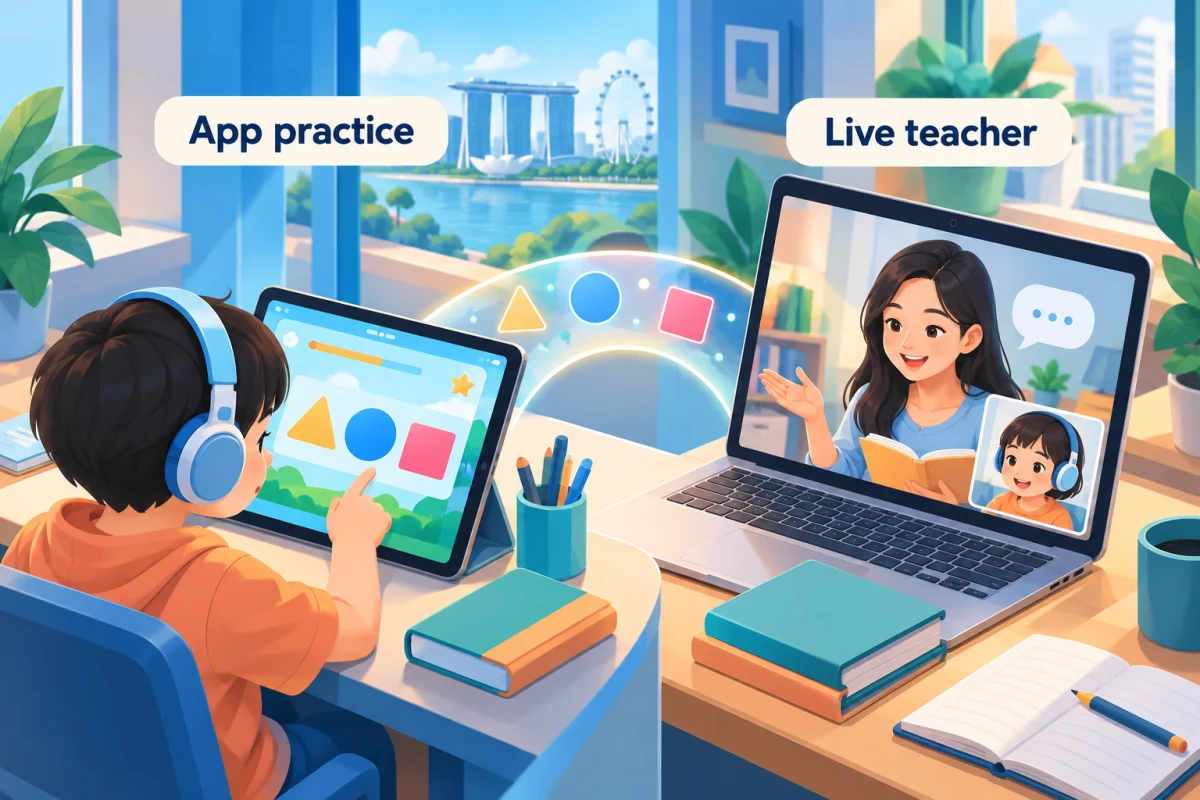
If you are choosing reading support for the September break, first ask what your child needs to practise. An app, a recorded demonstration and a live teacher offer different kinds of interaction. The most useful choice depends on the task and the help required.
Start with a concrete observation
“Can match pictures but cannot blend these taught sounds” gives you a clearer question than “Needs better English”. Ask the teacher what to practise and how to recognise a useful attempt.
The 2026 September school vacation runs from 5 to 13 September. It is a short break, not a deadline to complete a reading curriculum.
Compare the support
| Question | App or recorded resource | Live teacher |
|---|---|---|
| Can the same example be repeated? | Often, depending on the product. | The teacher can model it again during the lesson. |
| Who interprets an unexpected answer? | Feedback depends on the software; a caregiver may need to investigate. | The teacher can ask a follow-up question and respond. |
| Can the task be matched to current teaching? | Check the sequence and specific activities. | Discuss placement and the current focus with the teacher. |
| What practical setup is needed? | Device, access and caregiver checks. | A booked time, working audio/video and the requested materials. |
This describes common format differences, not a rating of every product or a guarantee of a particular outcome.
Check what the child is actually doing
Correctly tapping a picture is different from reading a printed word. Watch one activity and ask whether it practises the intended skill. A completed level or high score does not by itself establish transfer to a book.
After suitable digital practice, offer a small matched print task. Note what support was required and discuss it with the teacher. Do not introduce a difficult unfamiliar page merely to “test” the app.
Use a fair trial
For an app, check current content, cost, access conditions and suitability before purchasing. For live support, ask about the assessment, lesson focus, caregiver role and feedback. Decide using actual observations rather than a promise of rapid results.
PLA online phonics is live 1-to-1 for ages 4–8, in 30-minute sessions. It can provide teacher-led practice; a suitable digital resource may serve a separate home-practice purpose.
Calendar source: 2026 MOE calendar from North Spring Primary School.
Related reading
- Screen Time with a Purpose: Best Phonics Apps and Videos That Actually Help
- Is a Live Online Phonics Class Suitable for My Child?
Discuss your child’s next step
If you would like help choosing suitable reading practice, book a complimentary assessment or explore our reading programme.