Rhyming games invite children to listen to how words sound. They do not need to read the words first. A child who supplies a rhyme may be joining in from memory or listening carefully; that response alone does not show they have decoded a printed word.
Start with a choice
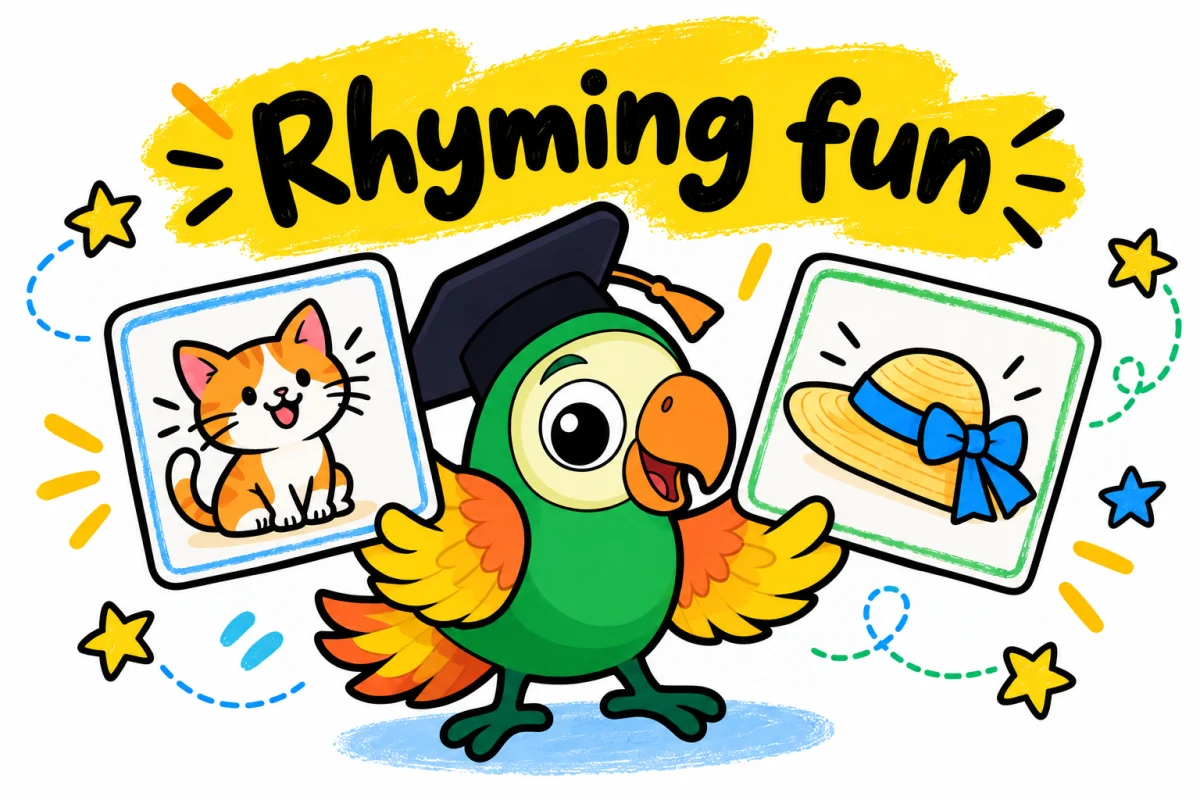
Put a toy cat and a hat on the table. Say “cat, hat” and emphasise the shared ending. Then offer a non-rhyming word: “Does cat sound like hat or sun at the end?” Let your child point instead of requiring a spoken answer.
If the choice is difficult, model it: “Cat and hat sound alike at the end.” Repeat the pair and move on. There is no need to explain spelling yet.
Try three small games
- Choose the pair. Use pictures of a cat, hat and dog. Say the words yourself and find the pair together. Check that the child knows what each picture represents.
- Finish a spoken line. Say “The cat wore a…” and offer “hat” or “cup”. Enjoy a silly answer, then say the rhyming pair again.
- Make up a rhyme. Once choosing is easy, ask “What sounds like sun?” Model “fun” if needed. A playful invented word can be enjoyed as sound play; explain that it is not an ordinary word.
Match the activity to the task
Recognising a rhyme and generating one are different demands. If your child can select a pair but cannot invent a rhyme, stay with selection instead of assuming they have forgotten everything.
Keep the game spoken unless you specifically want to practise taught print. Do not ask your child to read an unfamiliar picture label just to participate.
Rhyme, syllables and phonemes are different
Clapping pic-nic marks two spoken syllables. Identifying the first sound in sun concerns an individual phoneme. Rhyming sun with fun concerns their shared ending. These activities can sit alongside one another, but they are not interchangeable tests.
Connect to books without turning pages into quizzes
Read a rhyming story aloud and occasionally invite your child to join a familiar line. Continue telling the story if they prefer to listen. When practising actual word reading, return to text whose letter–sound patterns they know.
Ask the teacher which listening or reading task is currently useful. One brief game during a quiet moment is more manageable than a new worksheet after every story.
Related reading
- Storytelling at Home: Enjoy the Story, Then Try a Sound Activity
- My Child Knows Letter Sounds but Cannot Blend: What Can I Try?
Discuss your child’s next step
If you would like help choosing suitable reading practice, book a complimentary assessment or explore our reading programme.