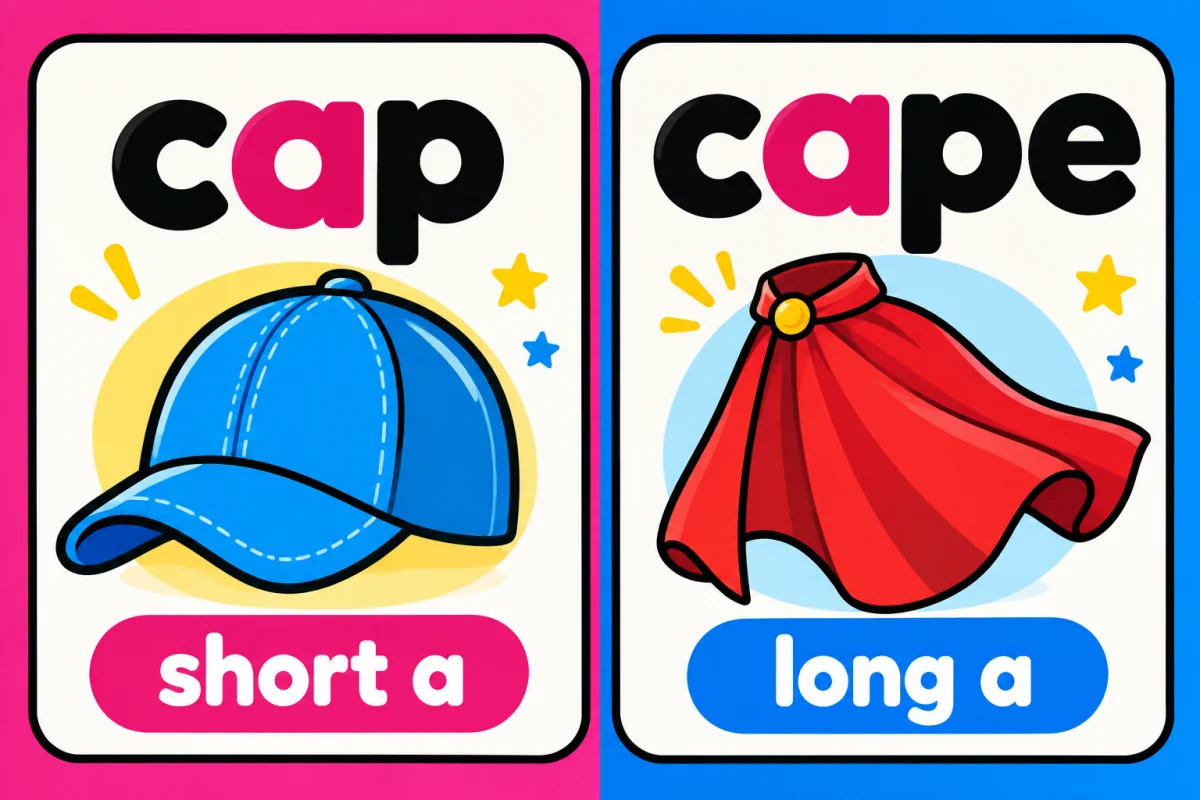
In early phonics materials, “short” and “long” are names for groups of vowel sounds. They do not simply mean saying a sound for a shorter or longer time. A long vowel often sounds like the letter’s name; spelling patterns help indicate which sound a word uses.
Begin with a taught pair
Use cap and cape only if your child has been taught the relevant patterns. Say both words and check their meanings. A picture of a cap and a cape can support that discussion.
Write cap and read it together. Add the final e, show cape and model its changed vowel sound. Say the whole word after joining the sounds. Ask your child to read with you before trying alone.
Describe the pattern carefully
In these examples, final e signals a different vowel sound. It does not follow that adding an e changes every word in the same way. Words such as have do not follow this simple example. Introduce exceptions when they arise in the teaching sequence.
The pronunciation used in an audio model may also differ by accent. Ask the teacher for the sound model they use; avoid treating an accent difference by itself as a reading error.
Try a read-and-sort activity
- Choose two or three taught pairs, such as cap/cape or kit/kite.
- Read each word, with modelling where needed.
- Sort by the vowel sound in the spoken word.
- Point to the spelling that signals the difference.
- Choose one word and explain what it means.
If your child guesses from the picture, return to the print and model it. If the pattern is unfamiliar, pause and ask the teacher what to practise instead.
Vowel teams are another step
In rain, the letters ai represent the vowel sound. In feet, ee does so. These are not the same written pattern as final e. Teach the particular correspondences your child is learning rather than a rule that the first vowel always “does the talking”.
Connect the pattern to a small passage
Use a teacher-matched sentence containing the pattern and any other known words. Reading a familiar pair in isolation can be easier than applying it in a passage; note the help needed in each task.
For the end of the June break, choose a small review rather than a large list of new spellings. Share an actual attempt with the teacher and ask which pattern should come next.
Related reading
- Digraphs and Consonant Blends: A Clear Guide for Parents
- Syllable Patterns: What Parents Need to Know
Discuss your child’s next step
If you would like help choosing suitable reading practice, book a complimentary assessment or explore our reading programme.