If your child remembers a spelling list for one evening but struggles the next day, look at how they are practising. Copying a word repeatedly, spelling it from memory and using it in writing are different tasks. Ask the teacher which patterns and words are currently being taught.
Choose a small matched set
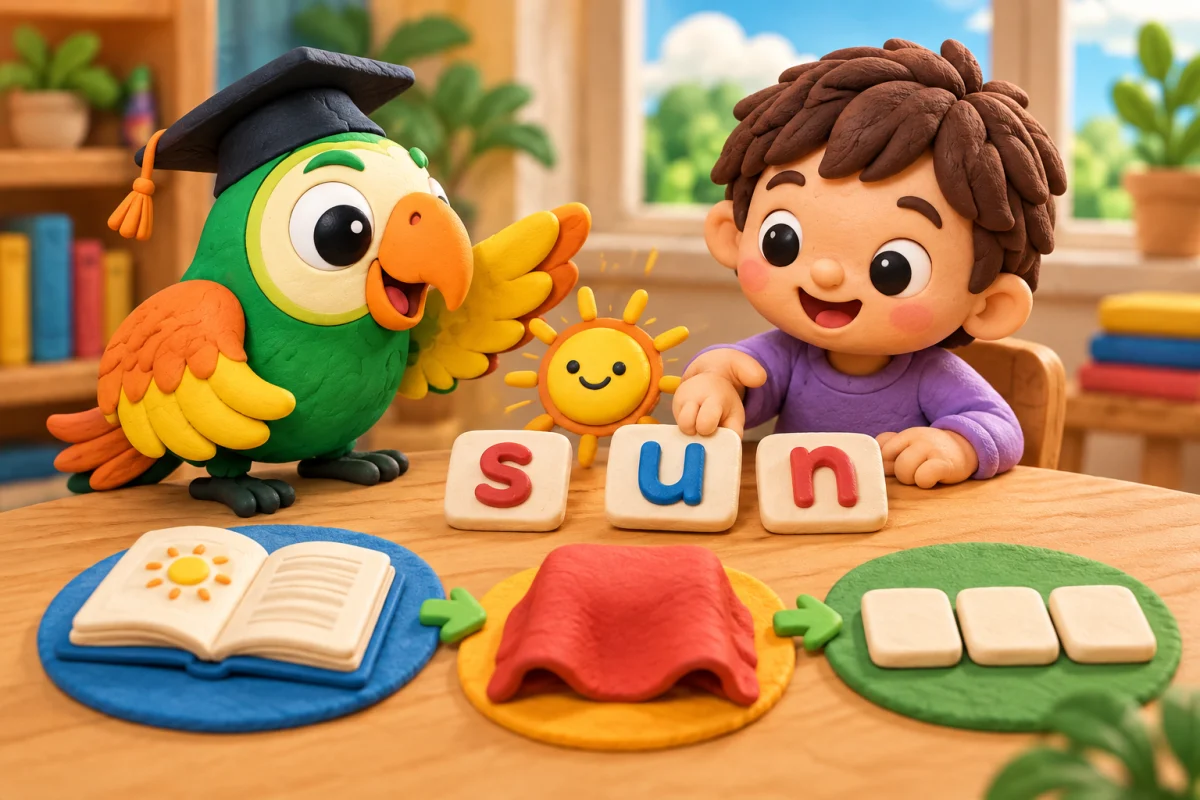
Use a few familiar words rather than adding a second large list to school homework. The example below uses sun, assuming its letter–sound relationships are known. Do not apply the same routine blindly to words with untaught spellings.
Say, segment, build, write, check
- Say: say “sun” naturally and check its meaning.
- Segment: model the individual sounds in order. Use a counter for each sound if helpful.
- Build: choose the spellings representing those sounds using letter tiles.
- Write: cover the model and invite the child to write the word once, with help if needed.
- Check: reveal the model, compare and explain any difference together.
If a spelling represents one sound with two letters, keep those letters together when explaining it. In ship, for example, sh represents one phoneme.
Make an error informative
If your child writes sn for sun, say the whole word, model its sounds and look at which spelling is missing. Avoid simply requiring ten extra copies.
The written response does not establish why the error happened. A useful note is “Needed a model to include the middle vowel”, which you can share with the teacher.
Use the word with meaning
Say a short sentence together. If the sentence contains other unfamiliar spellings, write those as an adult model and ask only for the target word. For example, you can write the surrounding sentence while the child supplies sun.
On another day, revisit the small set before adding more. Compare the help needed rather than treating one perfect attempt as permanent mastery.
For words with unfamiliar spellings
Ask which parts can be explained using taught patterns and which part needs explicit introduction. Do not tell your child that all common words must be memorised as whole shapes. High-frequency words include both familiar and less familiar spelling relationships.
Coordinate with school
For P1 or P2 spelling, bring a real example to the teacher and ask how the word was taught. Agree on one home routine that complements class practice. Keep handwriting difficulty, spelling knowledge and understanding of the word as separate observations.
Related reading
- Digraphs and Consonant Blends: A Clear Guide for Parents
- Silent Letters and Tricky Words: How to Help Your Child Tackle Irregular Phonics Patterns
Discuss your child’s next step
If you would like help choosing suitable reading practice, book a complimentary assessment or explore our reading programme.